

Decline and Fall or Crisis and Resilience: A New Approach
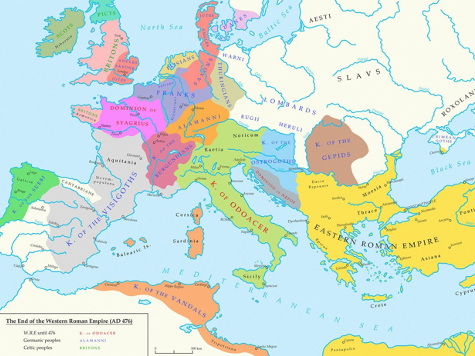
Over the course of the fourth through seventh centuries, Rome witnessed a succession of significant political and military crises. Historians have traditionally considered these crises as defining events, and thus critical to our understanding of the "decline and fall of Rome." In this talk, Michele Renee Salzman offers a fresh interpretation of the tumultuous events that occurred in Rome that resulted in the demise of the last Western Roman emperor.
Focusing on the resilience of Roman men and women and their ability to reconstitute their city and society in the 470s, I demonstrate the central role that the senatorial aristocracy played, and the limited influence of the papacy during this period. This study thus provides a new explanation for the longevity of Rome in the last centuries of the western Empire.
Michele R. Salzman is Professor of History at University of California, Riverside. Salzman's research focuses on the religious and social history of Late Antiquity. She is author of On Roman Time: The Codex-Calendar of 354 and the Rhythms of Urban Life in Late Antiquity (UC Press, 1990), and numerous articles on Roman history and religion. Before joining the faculty at the University of California, Riverside in 1995, Salzman taught at Swarthmore College, Columbia University, and Boston University. Salzman has received research fellowships from the National Endowment for the Humanities, American Council of Learned Societies, the American Philosophical Society, and the Whiting Foundation.